
Where a Value Line's Unit Cost Comes From: Two Partnership Models
Two fragrance partners can quote the same value line and arrive at a similar unit cost through completely different routes. A development-led partner spends more on the front end and less on rework; a production-led partner spends less on development and more on coordination, packaging compromise and the occasional second sample round. Comparing the two quotes line by line, rather than at the bottom line, is the only way to see which one fits the line you are building.
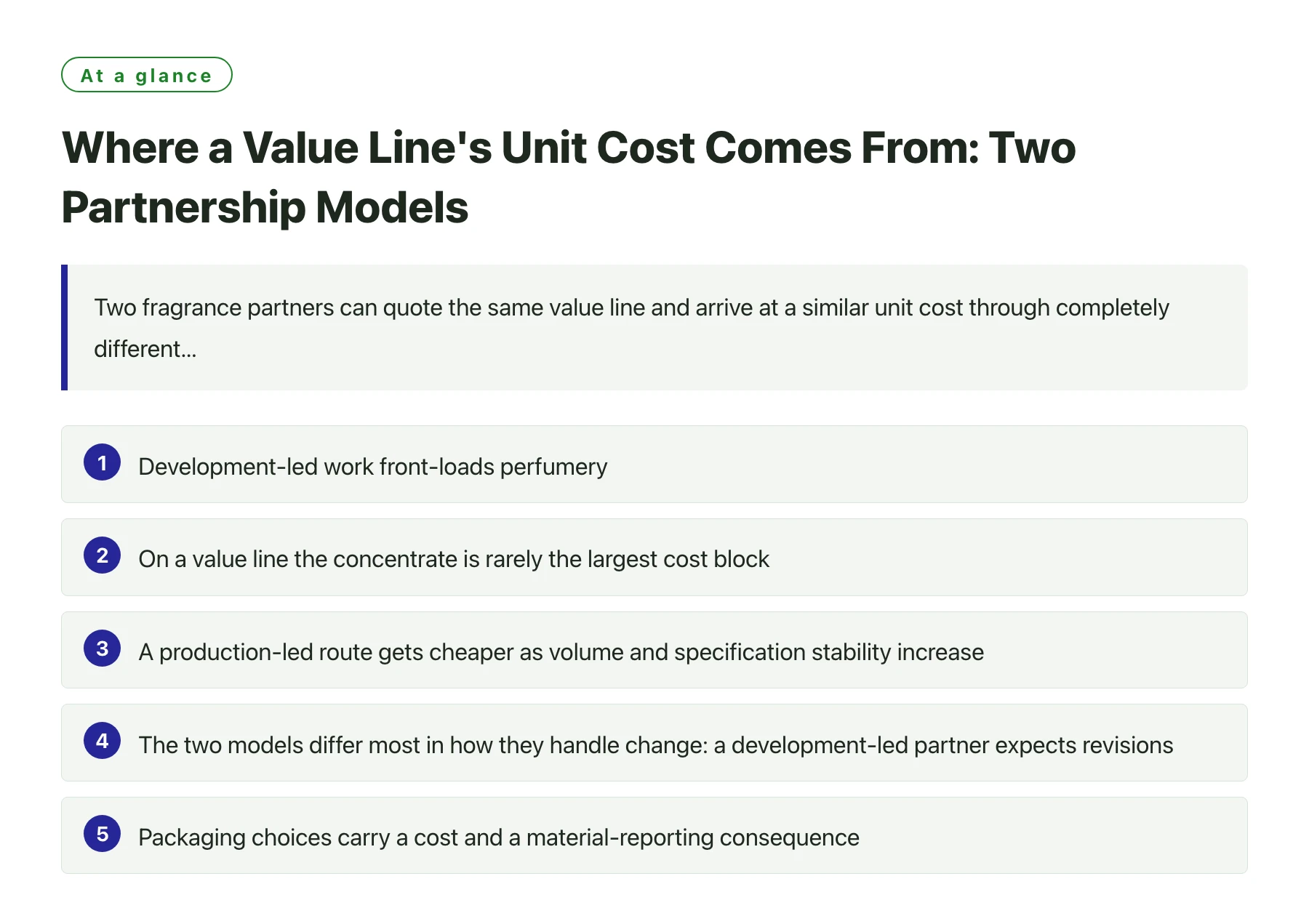
Key takeawaysDevelopment-led work front-loads perfumery, evaluation and documentation; production-led work front-loads tooling, components and volume commitments. · On a value line the concentrate is rarely the largest cost block; packaging, filling and freight allocation usually decide the unit cost. · A production-led route gets cheaper as volume and specification stability increase, and more expensive as either one falls. · The two models differ most in how they handle change: a development-led partner expects revisions, while a production-led partner prices them separately. · Packaging choices carry a cost and a material-reporting consequence, so a value line should weigh both when it selects a component [3]. · Category reporting on where value and mass tiers are moving is a reasonable input for deciding how much development the line can support [1].
Most cost conversations about fragrance start at the wrong place: the price of the concentrate. On a premium line that may be defensible. On a value line the concentrate is often one of the smaller blocks of the delivered cost, and the decisions that move the number most are made before any perfumer is involved.
This article compares two ways of working with a manufacturing partner and shows what each one does to the same cost blocks. The purpose is not to recommend one model, but to make the comparison honest, because the two quotes usually arrive in different formats and are therefore never really compared.
The same cost blocks, two different shapes
| Cost block | Development-led partner | Production-led partner |
|---|---|---|
| Scent development | Included in the brief-to-sample route; several evaluation rounds expected | Library match or a light adaptation; fewer rounds, narrower scope |
| Formula stability and testing | Planned into the schedule and quoted as part of development | Often treated as a separate line or assumed from similar products |
| Packaging and components | Chosen against the cost band and compatibility-tested early | Selected from available stock components, which constrains the design |
| Tooling and decoration | Later, after the scent and pack direction are settled | Earlier, because the component choice effectively fixes the decoration route |
| Minimum order quantity | Lower first quantities are more often negotiable | Tied closely to component minimums, which can dominate the total |
| Change handling | Revisions are part of the development loop | Revisions are quoted when they occur, and the quotation is where the risk sits |
| Documentation handover | Produced alongside development and handed over at approval | Assembled at the end of the order cycle, sometimes to a template |
Read the table as a risk map rather than a price list. Each row tells you where a model is comfortable and where it will charge you for adapting.
Why the bottom line hides the difference
A quote that includes development and a quote that excludes it are not comparable, and on a value line this is not a small adjustment. The development-led quote carries extra work that reduces the number of sample rounds later; the production-led quote carries a smaller front end and a larger probability of a revision once the first samples are evaluated. Both are legitimate cost structures. The mistake is choosing between them on the headline number.
The useful comparison is a delivered unit cost at a stated volume, with the same fill size, the same packaging assumption and the same documentation scope. Only then does the difference between the two models become visible. In practice buyers find that the models converge at higher volumes and diverge sharply at low volumes, because fixed development work is spread over more units while component minimums are not.
It also helps to separate cost blocks that move with volume from those that do not. Tooling, artwork setup and development work are largely fixed. Concentrate, components, filling and freight scale with quantity. A value line's margin is usually decided by the fixed blocks at low volume and by the variable blocks at high volume, which is why the same line can look attractive and unattractive within a single year.
The three hidden lines in a value quote
The first is the change order: what a revision costs after the specification is signed. The second is the packaging substitution: which component the price assumes and what happens if it is unavailable. The third is the documentation scope: whether the price includes the declarations and reports the label will need. None of the three is dishonest to leave out, and all three change the delivered cost when they are triggered.
Choosing the model by what your line actually is
A value line with a stable specification, two sizes and a repeatable scent is a natural fit for a production-led relationship. The work is defined, the components are settled and the cheapest competent producer wins on execution. The same line at launch, before any of those things are settled, is usually better served by a partner that develops, because the cost of an unresolved brief shows up as a second sample round and a delayed window rather than as an invoice.
Where a line spans both situations, a mixed structure is common and often sensible: develop the hero scent with the first partner, then move to a production-led arrangement once the specification is frozen. The risk in that split is the handover, and the two documents that make it survivable are the approved standard sample and the written specification that describes it. Without them, the second partner is reproducing a memory.
Some suppliers are deliberately organised to serve both routes, and comparing how a candidate describes its scope is informative. A business that presents itself as a perfume OEM/ODM manufacturer is claiming development and production under one roof, which changes the handover question; a candidate that describes itself as a manufacturer that supports OEM and ODM is telling you it expects to be selected for one service shape rather than for both.
Industry coverage of process control and production economics is a useful background for these conversations, because it makes the cost drivers legible without relying on a single supplier's account of them [2]. The strongest version of the exercise is to build the cost model yourself, with your own assumptions, and then ask each candidate to fill in the blanks. A partner that can explain its numbers is a partner that can defend them later.
The final question to settle is what the line is optimising for. If it is optimising for the lowest possible unit cost at a fixed specification, the production-led route is usually correct. If it is optimising for a scent and pack that no competitor can match, the development-led route is usually correct, because the a single partner from formula to finished bottle arrangement keeps the brief, the formula and the components inside one set of hands. Most value lines are actually optimising for the first while believing they are optimising for the second, and that mismatch is the most expensive thing in the whole exercise.
A practical way to close the comparison: ask both candidates for the cost of a repeat order, not the first one. The second order strips out the development and setup blocks and exposes the steady-state unit cost. If the two models look similar on the first quote but very different on the second, you have found the real difference between them.
Sources
- Cosmetics Business —— A trade publication covering the beauty and cosmetics industry, including fragrance launches and regulatory developments.
- Cosmetics & Toiletries —— A technical magazine for cosmetic formulators, covering ingredients, formulation science and testing methods.
- European Commission: Packaging Waste and the PPWR —— EU rules on packaging and packaging waste, including the Packaging and Packaging Waste Regulation requirements on recyclability and design.
Frequently asked questions
Is a production-led partner always cheaper for a value line?
Not always. It is usually cheaper at stable specifications and reasonable volumes. At launch, when the brief is still moving, the revision costs can erase the saving, and a development-led partner's higher front end can end up cheaper overall.
Should development and production be split between two suppliers?
It can work when the specification is genuinely frozen and the handover documents are complete: an approved standard sample, a written specification and a documented component list. Without those, the second supplier is guessing, and the cost of guessing usually appears as a rejected batch.
How many quotes are enough to understand the market for a value line?
Three well-structured quotes at the same volume and packaging assumption are more informative than six informal ones. Ask each candidate to price the same deliverable and to state what it excludes, then compare the exclusions rather than the totals.
Which cost block should a value line attack first?
Packaging and component choice, because it usually accounts for the largest share of the delivered cost and it can be changed without touching the scent. Concentrate optimisation comes second, and tooling comes last because it is difficult to reverse.
What makes two fragrance quotes genuinely comparable?
The same fill size, volume, packaging assumption, documentation scope and delivery terms. Any difference in those five turns the comparison into an estimate, and estimates are how value lines end up with a unit cost nobody agreed to.
Ready to build the partnership your horse has been waiting for?
Start with the free 7-day Foundation — pressure-and-release fundamentals, taught by the horse, in your inbox.
Start With the Free 7-Day Foundation No credit card · 218,000+ downloads since 2019